Recently, the State Administration for Market Regulation and the Standardization Administration of China officially released the mandatory national standard GB 26572-2025 Requirements for the Restriction of the Use of Hazardous Substances in Electrical and Electronic Products. The introduction of this standard marks a new phase in the management and control of hazardous substances in China’s electrical and electronic products industry and is expected to have a profound impact on the sector.
1. Basic Standard Information
- Release Date: August 1, 2025
- Effective Date: August 1, 2027
- Transition Arrangement: 2-year transition period + 1-year sell-off period for existing inventory
2. Rationale for the Standard
Formulated to implement the *”14th Five-Year” Industrial Green Development Plan* of the Ministry of Industry and Information Technology (MIIT), this standard will leverage the supportive role of mandatory national standards in hazardous substance control for electrical and electronic products, further improving the control mechanism by:
- Enhancing consumer health protection and environmental risk management.
- Facilitating international trade of electrical and electronic products.
- Promoting higher-quality and more sustainable development of the electrical and electronic industry.
3. Key Content Overview
3.1. Scope and Positioning
This is the first mandatory national standard in the field of China RoHS regulation. It specifies the types of restricted substances, limit values, and test methods, aligning with international RoHS control requirements.
Scope: Electrical and electronic products manufactured, sold, and imported within China, consistent with the Administrative Measures for the Restriction of the Use of Hazardous Substances in Electrical and Electronic Products.
3.2. Product Categories & Control Requirements
China RoHS fully implements a control system of “Compliance Management Catalog + Conformity Assessment + Post-market Supervision”:
- Products listed in the Compliance Management Catalog: Must meet the hazardous substance limit requirements and undergo conformity assessment via either state-backed voluntary certification or self-declaration.
- Products not listed in the Catalog: Still need to be controlled according to the standard’s requirements.
The first batch of the Catalog includes 12 product categories: Refrigerators, Air Conditioners, Washing Machines, Printers, Copiers, Fax Machines, Televisions, Monitors, Microcomputers, Mobile Phones, Telephones.
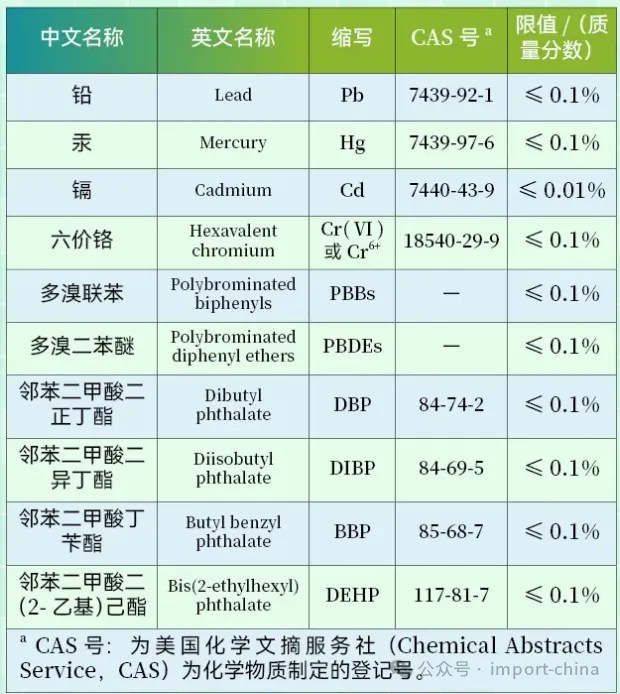
3.3. Restricted Hazardous Substances & Limit Values
The standard sets limit requirements for 10 categories of hazardous substances. The content of these substances in each homogeneous material of a product must not exceed the specified limit values.
3.4. Test Methods
The determination of hazardous substance content in electrical and electronic products shall be conducted using the methods specified in the corresponding parts of the national standard GB/T 39560 series (Determination of certain substances in electrical and electronic products). This series of standards is identical to the IEC 62321 series, ensuring international alignment.
3.5. Marking Requirements
Producers or importers of electrical and electronic products must mark their products based on the presence of hazardous substances:
- Label I (Green): Indicates the product contains no hazardous substances and is environmentally friendly.
- Label II (Orange): Indicates the product contains hazardous substances but can be used safely within its Environmental Protection Use Period.
Symbol Meaning: The arrows forming a circle around the symbol indicate that the electrical and electronic product is recyclable.
Label I can only be used on the product surface if all homogeneous materials in the product comply with the limit requirements; otherwise, Label II must be used.
3.6. Documentation Retention Requirements
Enterprises are required to maintain a product compliance declaration and technical documentation. This documentation must be authentic, valid, and traceable.
4. Implementation Schedule
The “2+1” Implementation Plan:
- The standard was released on August 1, 2025, and becomes effective on August 1, 2027 (2-year transition period).
- For products manufactured or imported before August 1, 2027, the standard’s requirements take effect from August 1, 2028 (1-year sell-off period for inventory).
5. Significance & Recommendations
The implementation of this mandatory national standard will significantly strengthen the control of hazardous substances in electrical and electronic products, protecting consumer health and environmental safety, promoting green industrial upgrades, and enhancing the international competitiveness of China’s products.
Recommendation for Enterprises: Relevant companies should familiarize themselves with the standard’s requirements as soon as possible, establish and improve their hazardous substance control systems, and ensure product upgrades and technical transformations are completed within the transition period to meet the new standard’s requirements.
 助力您的货物或商品顺利进入中国口岸,打开中国市场
Leave a comment